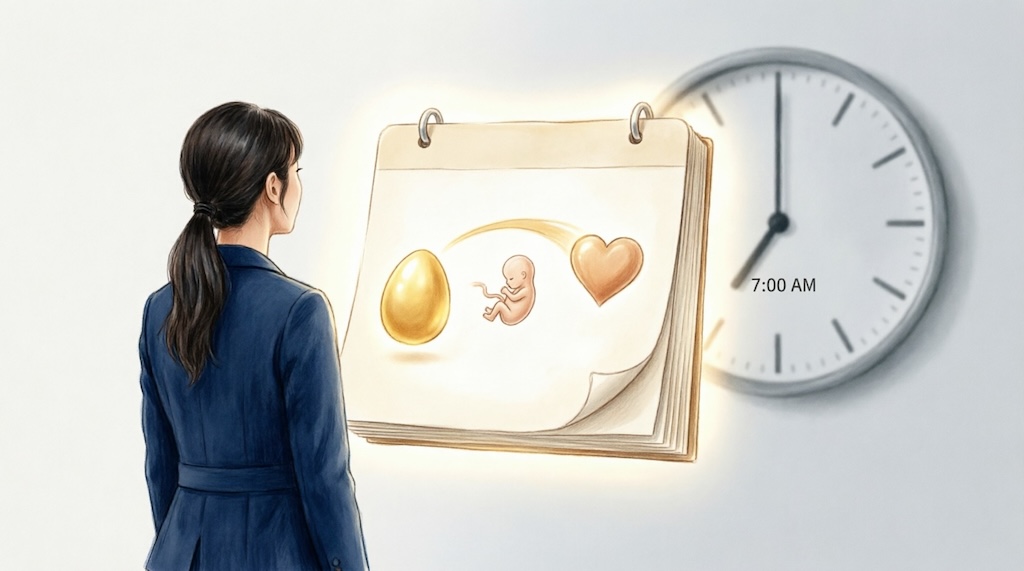
What Is IVF? The 5-Minute Explanation for Busy Working Women
You have heard the letters *I-V-F* whispered in office hallways, mentioned in celebrity news, and maybe suggested by your gynecologist. But nobody has actually sat you down and explained what IVF is—without the medical textbook language or the scary statistics.
Here is the truth: IVF is not a last resort. It is not science fiction. And it is definitely not something you need a PhD to understand.
IVF (In Vitro Fertilization) simply means: egg meets sperm in a lab, instead of inside your body.
That is it. Everything else—the injections, the appointments, the cost—is just logistics.
By the end of this 5-minute read, you will understand exactly what IVF is, how the process works around a full-time job, and whether it might be right for you.
The 30-Second Definition (For When Your Boss Asks Why You Need Friday Off)
IVF stands for In Vitro Fertilization. “In vitro” is Latin for “in glass” (think: petri dish, not a wine glass). A doctor retrieves your eggs, combines them with sperm in a lab to create embryos, then transfers one or more embryos into your uterus.
Why do people do it? IVF helps bypass common fertility problems like:
- Blocked or damaged fallopian tubes
- Male factor infertility (low sperm count or motility)
- Ovulation disorders (PCOS, endometriosis)
- Unexplained infertility (doctors can’t find a specific cause)
- Preserving fertility before cancer treatment or age-related decline
Can any woman do IVF? Generally, yes—as long as you have a uterus and some ovarian reserve (eggs). But success rates vary dramatically by age (more on that below).
The IVF Process Explained in 6 Simple Steps (With Realistic Timelines)
Here is where most articles lose you. They list 47 steps, each with a Greek name. I am giving you 6 steps—and telling you exactly how much calendar time each takes.
Step 1: Ovarian Stimulation (10–14 days)
What happens: You give yourself daily hormone injections (small needles, subcutaneous—like an insulin shot) to encourage your ovaries to grow multiple eggs instead of the usual one.
For a busy woman: You inject at home, usually in the evening. Most women do it while watching Netflix. You will visit the clinic for bloodwork and ultrasounds every 2–3 days—typically before work (7 AM appointments exist for this reason).
Time commitment: 15 minutes per evening + 3 early mornings per week.
Step 2: Egg Retrieval (One 20-Minute Procedure)
What happens: Under light sedation (you are asleep but breathing on your own), a doctor inserts an ultrasound-guided needle through the vaginal wall to aspirate the fluid from your follicles. This collects the eggs.
For a busy woman: You cannot drive afterward. Take the full day off. Plan to rest on the couch with a heating pad. Most women return to work the next day.
Time commitment: Half a day (procedure + recovery).
Step 3: Fertilization (3–5 days in the lab)
What happens: In the lab, an embryologist combines your eggs with sperm. In conventional IVF, they are placed together in a dish. In ICSI (pronounced “icky”), a single sperm is injected directly into each egg.
For a busy woman: You do nothing. This is the only step where you have zero appointments. Go to work, live your life.
Time commitment: Zero hours (the lab works for you).
Step 4: Embryo Development (Days 3–6)
What happens: The fertilized eggs (now called embryos) grow in a special incubator. By day 3, they have 6–8 cells. By day 5 or 6, they become a blastocyst—the stage most likely to implant.
For a busy woman: You will get a “embryo report” phone call on day 3 and day 5 or 6. That is it.
Step 5: Embryo Transfer (10–15 minutes, no sedation)
What happens: Using a thin, flexible catheter, your doctor places one (or sometimes two) embryos into your uterus. You are awake. It feels like a Pap smear.
For a busy woman: No recovery time needed. You can go back to work immediately. Many women do—though you might want to take the afternoon off for emotional reasons, not physical ones.
Time commitment: 1 hour (including waiting and prep).
Step 6: The Two-Week Wait (The Hardest Part)
What happens: You wait 10–14 days to take a pregnancy test. Your clinic may give you progesterone supplements (pills, vaginal suppositories, or injections) to support the uterine lining.
For a busy woman: This is psychologically brutal. Schedule low-stress work. Avoid Google. Do not test early. Plan a weekend away or a dinner with a trusted friend.
Visual Timeline: From Start to Pregnancy Test
| Week | What Happens | Work Impact |
|---|---|---|
| Week 1 | Ovarian stimulation (daily injections + 3 monitoring visits) | 3 early mornings |
| Week 2 | Egg retrieval (1 day off) + fertilization (no appointments) | 1 full day off |
| Week 3 | Embryo transfer (1 hour) + begin 2-week wait | Minimal |
| Week 4 | Pregnancy blood test | 1 hour (appointment) |
Total time away from work: Approximately 1.5 days + a few early morning appointments.
IVF Success Rates by Age (The Honest Numbers)
You need these numbers. Do not trust a clinic that quotes only their “best” statistic.
| Age | Live Birth Rate per IVF Cycle | # of Cycles Needed (Average) |
|---|---|---|
| Under 35 | 40–50% | 1–2 |
| 35–37 | 30–40% | 2–3 |
| 38–40 | 20–30% | 3–4 |
| 41–42 | 10–15% | 4–5 |
| Over 42 | 2–5% | 6+ (or donor eggs recommended) |
Source: CDC 2024 Assisted Reproductive Technology Report
What this means for you: If you are 38, do not assume “IVF failed” after one cycle. The average 38-year-old needs 2–3 cycles. Budget emotionally and financially for that reality.
How Much Does IVF Cost? (Real Numbers, No Surprises)
| Expense | Average Cost (USA) |
|---|---|
| One IVF cycle (medications + monitoring + retrieval + transfer) | $12,000–$20,000 |
| Medications (often separate) | $3,000–$6,000 |
| ICSI (if needed) | +$1,500–$2,500 |
| Genetic testing (PGT) | +$4,000–$6,000 |
| Embryo freezing + annual storage | $500–$1,000 per year |
| Total for one complete cycle | $15,000–$30,000 |
Insurance check: 19 states mandate some fertility coverage. Call your HR department. Do not assume you are not covered.
Cost-saving options:
-
Shared risk programs (pay for multiple cycles, get refund if no baby)
-
Fertility loans (LightStream, Future Family)
-
Clinical trials (some clinics offer discounted cycles for research participation)
-
Travel to lower-cost clinics (CNY Fertility in Colorado: $4,000 per cycle)
IVF vs. Other Fertility Treatments (So You Know Your Options)
| Treatment | What It Is | Best For | Cost |
|---|---|---|---|
| Ovulation induction (Clomid/Letrozole) | Pills to trigger ovulation, timed intercourse | PCOS, mild ovulation issues | $100–$500/month |
| IUI (Intrauterine Insemination) | Sperm washed and placed directly in uterus | Mild male factor, unexplained, cervical issues | $500–$2,000/cycle |
| Mini IVF | Lower-dose medications, fewer eggs, lower cost | Women with good ovarian reserve, avoiding heavy meds | $5,000–$10,000/cycle |
| Conventional IVF | High-dose meds, 10–15 eggs expected | Most diagnoses, especially low reserve or age >38 | $15,000–$30,000/cycle |
| IVF with Donor Eggs | Eggs from a young donor fertilized with partner/donor sperm | Age >42, POI, poor egg quality | $30,000–$50,000 |
Your first step: Try 2–3 cycles of IUI if you are under 38 with unexplained infertility. Otherwise, move directly to IVF.
Frequently Asked Questions (Voice Search Optimized)
Q: Is IVF painful?
The injections are pinpricks (minor). Egg retrieval is under sedation—you feel nothing. After retrieval, you may have cramps (like a bad period) for 1–2 days. Most women say the emotional pain is worse than the physical.
Q: Can I work during IVF?
Yes. Thousands of women do. Schedule monitoring appointments for 7 AM. Take retrieval day off. Work from home during the two-week wait if you can. Do not tell your boss until after a positive pregnancy test (unless you need accommodations).
Q: Does IVF cause menopause early?
No. IVF retrieves eggs that would have died anyway. You are born with 1–2 million eggs. You lose about 1,000 per month regardless of IVF. Retrieving 10–15 eggs does not accelerate menopause.
Q: Can I drink coffee during IVF?
Limit to 200mg (one 12oz cup) daily. High caffeine is linked to lower IVF success rates.
Q: How soon can I try again if IVF fails?
One full menstrual cycle (4–6 weeks). Your ovaries need time to recover. Many clinics recommend a “rest cycle” with no medications before repeating.
Q: Will IVF increase my risk of cancer?
Large studies (over 200,000 women followed for 20+ years) show no increased risk of breast, ovarian, or uterine cancer from IVF medications. The slight risk of ovarian cancer is linked to never having been pregnant—not the medications themselves.
The Webmaster’s Bottom Line (For the Busy Woman)
You made it to the end. Here is what you actually need to remember:
-
IVF is just lab fertilization. Not scary. Not experimental. Millions of healthy babies born.
-
The process takes one menstrual cycle. You will miss 1–2 days of work. You can absolutely do this with a full-time job.
-
Success rates drop after 38. If you are 38+ and want a baby, do not wait 6 months to “see what happens.” Schedule a fertility consult now.
-
Cost is the real barrier. Budget MYR20,000–MYR35,000 per attempt. Check your insurance. Ask about shared risk programs.
-
You are not alone. One in eight couples struggles with infertility. The woman next to you in spin class? She might have done three cycles.
Your next step: Book a 15-minute phone consult with a Reproductive Endocrinologist (REI). Most clinics offer free or low-cost initial calls. Bring your age, your cycle regularity, and any previous pregnancy history.
You have got this.
References (For E-E-A-T)
- CDC. (2024). ART Success Rates by Age. National Center for Chronic Disease Prevention.
- ASRM. (2023). Frequently Asked Questions About Infertility. American Society for Reproductive Medicine.
- Ethics Committee of ASRM. (2022). Financial counseling for fertility patients.
- SART. (2025). Clinic Summary Report. Society for Assisted Reproductive Technology.
Leave a Reply